



Traditionally, the safety and effectiveness of medicines are evaluated using the results of randomised clinical trials (RCTs) as evidence. Strengthening the use of real-world evidence (RWE) broadens the evidence on which decisions are made in regulation and health technology assessment (HTA), makes use of the increasing amount of health data available, and can accelerate decision-making. RWE is established in the post-authorisation phase of medicines, whereas it is only slowly gaining ground in the pre-authorisation and evaluation phase.
The interpretation of RWE has different demands comparing with RCTs, making it a necessity to train stakeholders to enable them to incorporate RWE in their decision-making. The demand for such training was demonstrated in Real4Reg’s publication “Key Stakeholders’ Knowledge, Opinions, and Interests on Real-World Evidence in the Regulatory Process – Results of an EU-Wide Survey”. Therefore, the expertise, results, and lessons learnt over the course of Real4Reg were channeled into the development of a training concept on data-driven decision-making.
The target audience of the Real4Reg training is all stakeholder groups involved in regulatory decision-making, including regulators, HTA bodies, payers, academia, industry, and patients. Due to the diverse target audience, a modular structure of the training was chosen, which allows training participants to select content relevant to them. It consists of four modules divided into several submodules. The modules build on each other; knowledge is acquired progressively.
The learning objectives and assumed prior knowledge for each module are made explicit in the beginning of the training, and you can find an overview below:
1. INTRODUCTION TO REAL-WORLD EVIDENCE IN REGULATORY DECISION-MAKING
You will learn about the foundations of regulation and HTA and how RWE contributes to these processes. Moreover, the use of artificial intelligence (AI) in analysing real-world data (RWD), particularly within the Real4Reg project, is introduced.
2. COMMON DATA MODELS WITH A FOCUS ON OMOP
2a. Motivation, Principles, and Characteristics
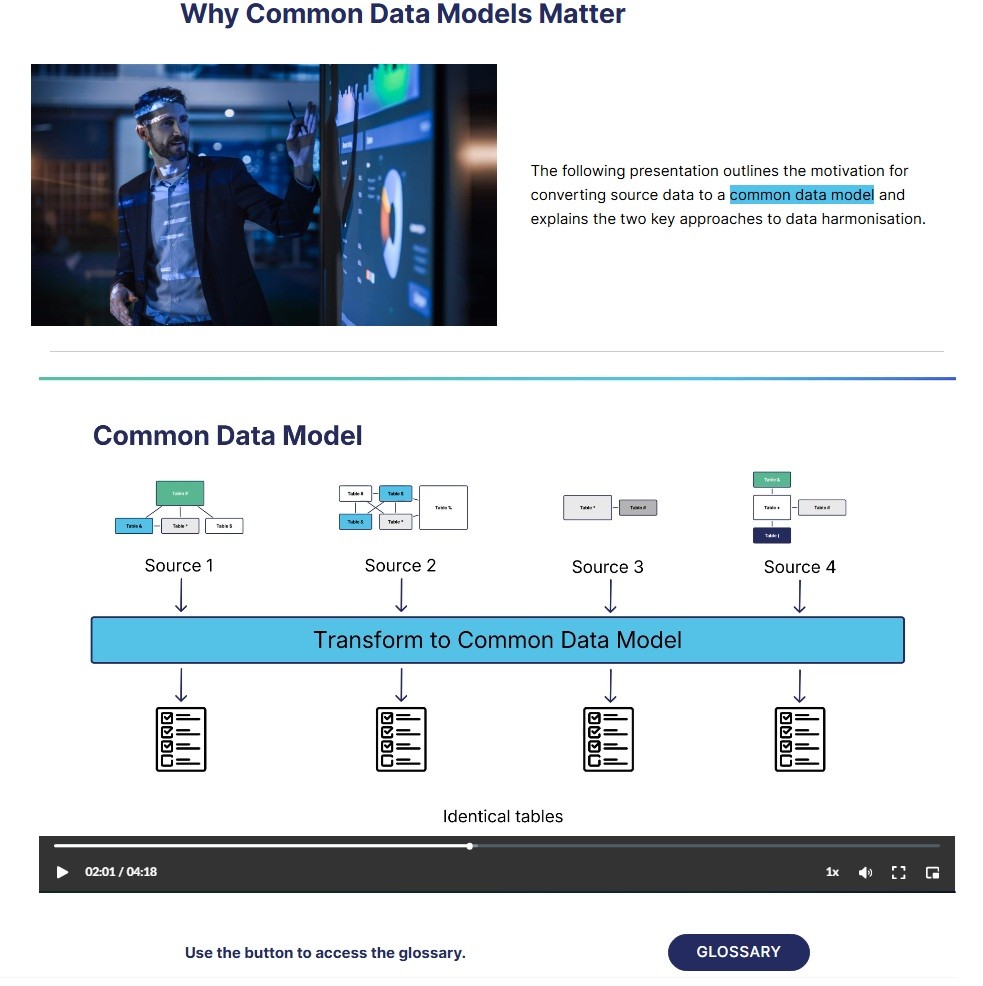
You will learn the fundamentals of common data models (CDMs), including the motivation behind using them, basic principles, and details on the Observational Medical Outcomes Partnership (OMOP) CDM.
2b. Hands-on Data Experience
This module describes specific challenges and solutions for mapping native data to the OMOP CDM, as they arose in the Real4Reg project. This part also highlights various aspects of data processing that are necessary to effectively comply with the OMOP standards.
3. GOOD PRACTICE EXAMPLES OF REAL-WORLD DATA ANALYSES
This module dives into practical examples of RWD analyses, including AI techniques. The module is divided into four submodules.
Examples From The Pre-Authorisation and Evaluation Phase:
3a. Description of Study Populations
This module gives an insight into the first good practice example from the EU project Real4Reg, which deals with the description of study populations. It aims to assess the value of RWD from national healthcare registers and claims data in generating high-quality, accessible, population-based information on amyotrophic lateral sclerosis and breast cancer.
3b. External Control Arms and Synthetic Data
Module 3b uses AI and machine learning (ML) methods to generate synthetic data for a specific subpopulation, as well as RWD-based external control arms for a trial. It seeks to demonstrate how RWD can contribute to answering questions that are not typically answered by RCTs, due to ethical or practical constraints.
Examples From The Post-Authorisation Phase:
3c. Descriptive Drug Utilisation Studies
Module 3c depicts descriptive drug utilisation studies on fluoroquinolones and sodium-glucose co-transporter 2 (SGLT2) inhibitors, including time trends of drug use, changes in user characteristics over time, and the impact of regulatory measures.
3d. Safety & Effectiveness Studies
Module 3d presents safety, drug effectiveness, and drug repurposing analyses; it investigates whether the risk for adverse drug reactions can be predicted on the population and individual patient-level using target trial emulation and causal ML.
4. TOOLS FOR REAL-WORLD DATA ANALYSIS IN ACTION: HANDS-ON ANALYSIS
This module allows you to dive deeper into some of the algorithms and tools you encountered in Module 3 by applying them to a freely available dataset. We will provide you with the algorithms that you can use to answer a scientific question based on an illustrative example. This module can be followed in a self-paced manner by following a Jupyter notebook.
Everyone can choose (sub)modules relevant to them based on their individual background and interests and at the end of each module participants obtain a certificate of completion if they successfully answer several questions.
Training Development and Delivery: The training material was developed and reviewed by Real4Reg consortium members and has been reprocessed by the service provider Universum to a standard for eLearning interoperability. Universum is an experienced provider of online trainings and will offer it through their learning management system. Be prepared for some interactive and creative learning experience!
Training Format and Registration: The training Modules 1, 2, and 3 will become available this autumn. Registered participants can work through in a self-paced manner. The link for registration will be published on the Real4Reg website and via other communication platforms in due time. Additionally, Module 4 is also planned to be offered as a self-paced online course.